








Here's a recipe for Classic French Buttercream. Please note: Classic French Buttercream is based on egg yolks. Yes yolks! That is what makes it richer than both the Swiss or Italian Buttercreams.
To prepare enough buttercream to frost a two layer 9-in. round cake, you'll need:

1 pound of unsalted butter
4 large eggs
1 cup granulated sugar
1/2 teaspoon table salt
2 tsp. pure vanilla extract
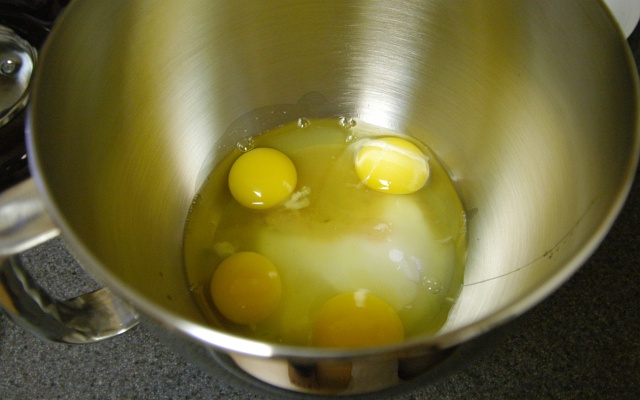
Start by cracking all four eggs into the metal bowl of a stand mixer. Add the sugar and vanilla extract to the bowl. Whisk until the eggs, sugar, and extract are evenly combined.


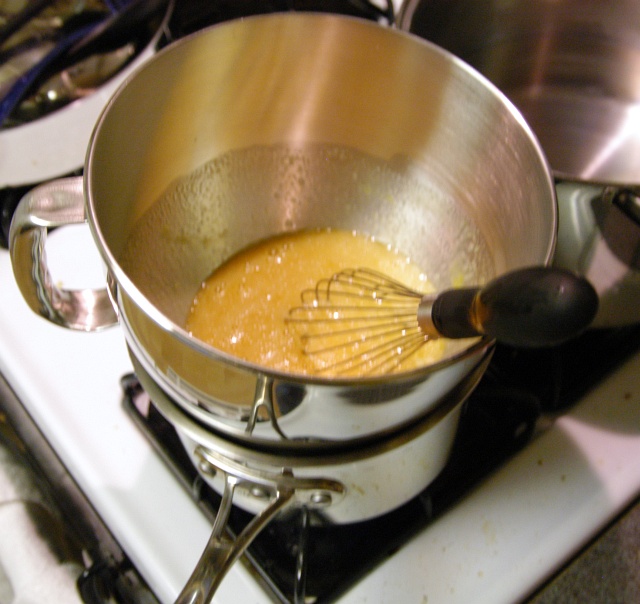
Find a pot that the mixing bowl can sit on without touching the bottom of the pan. Pour about 1/2-in. water into the pot and bring to a boil. Reduce heat to a simmer and place the m ixing bowl over the water pot to form a double boiler. This will allow you to heat the eggs slowly, minimizing the chances that the egg proteins will tighten up (forming scrambled eggs). Whisk continuously over the steaming water until the eggs reach 160°F.
 ixing bowl over the water pot to form a double boiler. This will allow you to heat the eggs slowly, minimizing the chances that the egg proteins will tighten up (forming scrambled eggs). Whisk continuously over the steaming water until the eggs reach 160°F.
 Once the mixture reaches 160°F, take it off the heat and beat on medium-high with the flat beater attachment for five minutes. The egg mixture will turn light yellow and fluffy. The mixture should have cooled by this time. Touch the side of the mixing bowl to check the temperature. If the mixture is too warm, it will melt the butter while you add it and the buttercream might not come together.

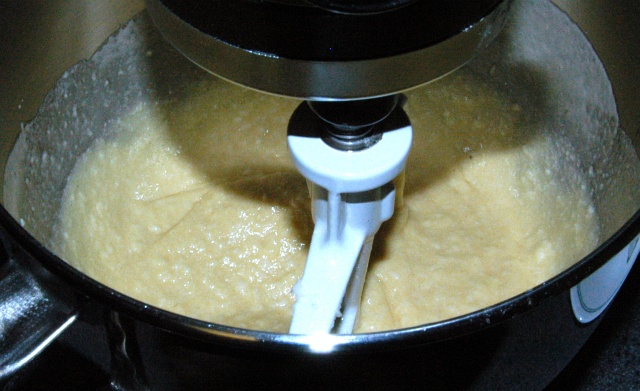
Reduce the mixer's speed to low and begin cutting pieces of butter into the mixer, waiting for ten to fifteen seconds before adding the next piece. One pound of butter should be cut into about 16 to 20 pieces (about 2 Tbs. per piece). During this process, the mixture will become lumpy, but don't worry about it, continue to cut pieces of butter into the mix until all the butter has been incorporated.
After all the butter has mixed in, continue to run the mixer until the mixture turns smooth and silky.
The final buttercream should be easy to spread onto the cake and should taste distinctly of sweet butter without any lumps or grittiness.
This is the last of the Buttercreams. As you can see they each require alot of work so I guess that is why so many people turn to store bought frostings but there is no comparison to homemade. Give it a try and you will see what I am talking about. ~ Chef Wilkinson ~


.jpg)
.jpg)
.jpg)
.jpg)

.jpg)
.jpg)




.jpg)